


Load regulation is a critical part of keeping equipment and devices safe during operation. It protects them from fluctuations in voltage and ensures inconsistent loads won’t damage or affect performance. A steady power source is often essential for dependable, ongoing operation, a necessity in many high-stakes applications like military and health care settings.
We’ll demystify load regulation by explaining what it is, how it works, and how you can measure it.
Quick Navigation:
Power supply regulation ensures electronic devices operate safely and efficiently. By maintaining a stable output voltage, regulation protects sensitive equipment from voltage fluctuations that could lead to malfunctions or damage. This is especially critical in industries such as telecommunications, aerospace, and consumer electronics.
Regulation is achieved through components such as output amplifiers, sense circuits, and error amplifiers, which work together in a feedback loop to detect and correct voltage deviations. Effective power supply design incorporates regulation mechanisms to prevent issues like voltage drop in circuits, which can compromise device performance. These mechanisms include load regulation, which maintains consistent output voltage despite changes in the load, and line regulation, which provides stability even when input voltage varies.
Load regulation allows a power supply to maintain a constant voltage, regardless of any variations in the output load. Many changes can affect the output load, like a change in resistance, so a power supply needs to ensure a constant, dependable output to provide reliable power to equipment.
In other words, it describes how much the load voltage changes as current demand increases or decreases. Some of the components involved in the load regulation commonly include an output amplifier, a sense circuit, and an error amplifier. Here’s how they might achieve load regulation in a power supply:
Once the signal is regulated, it allows the power supply to maintain a constant voltage for the powered device.
Another option is to use a Zener diode, which maintains a constant voltage with the help of integrated circuits and a negative feedback design.
Factors That Affect Reliability
Load regulation is calculated by comparing the load voltage at minimum load and maximum load to the nominal output voltage. This number indicates how much the output of the power supply will vary. Ideally, this number would be zero. That isn’t achievable in the real world, but you should aim to keep load regulation as close to zero as possible. Good load regulation can typically keep the variability under 5%.
Line regulation is determined by measuring the change in output voltage as the input line voltage shifts from low line to high line while the load current remains constant. The calculation for load regulation is:
Vmin-load and Vmax-load refer to the voltages at minimum and maximum loads, respectively. Vnom-load is the nominal voltage or the specified output voltage.
Understanding the load regulation calculation is crucial for engineers to design power supplies that meet specific performance criteria.
Power supplies must adhere to power supply regulations and industry standards that define safety, EMC, and power quality requirements. Regulatory bodies such as the International Electrotechnical Commission set the benchmarks for design and manufacturing, confirming power supplies meet the necessary criteria for efficiency and reliability. Some examples include:
Compliance with these standards is crucial for manufacturers, as it ensures power supply designs can handle various load conditions without causing voltage drop in circuits.
Regulation plays a pivotal role in power supply design by supplying devices with a consistent and reliable power source. This enhances the equipment’s performance and longevity while reducing downtime risk. In high-stakes environments, regulation is vital for maintaining operational integrity.
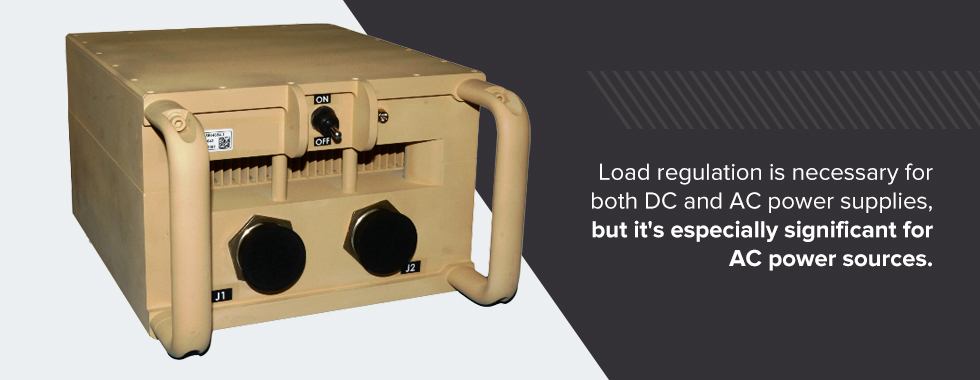
Load regulation is necessary for both direct current (DC) and alternating current (AC) power supplies, but it’s especially significant for AC power sources. In these supplies, load regulation is heavily influenced by the output frequency. Without load regulation, both types of power supplies can damage connected equipment through power spikes and drops.
If the electrical load decreases, the output voltage surges and vice versa. These fluctuations can damage components and circuitry or affect how the device works. For example, a drop in output voltage can result in equipment not receiving a high enough voltage for its intended operation. It may shut down altogether or operate poorly.
Good load regulation ensures the power supply delivers the voltage necessary for proper equipment operation and keeps it stable throughout the system.
When buying power supplies, you must pay attention to the load regulation specifications in your product’s documentation. It should specify a load regulation percentage and a load range for which the percentage is appropriate. Your power supply needs to provide power within that specified load current range. If it doesn’t, you could risk improper load regulation and damage to the device.
Here are a few examples of power supplies with these specs:
Load regulation is typically measured with resistors or programmable loads. You can test regulation on a new power supply to ensure it works as advertised and matches the specifications provided. Of course, it’s also useful for troubleshooting and repairs.
Load regulation is typically measured with resistors or programmable loads. You can test regulation on a new power supply to ensure it works as advertised and matches the specifications provided. Of course, it’s also useful for troubleshooting and repairs.
The process is similar for AC power supplies but requires additional considerations due to the alternating nature of the current and voltage.
Difference Between AC & DC Power Supplies
Load regulation is similar to line regulation. Both measure how well a power supply maintains a steady output voltage, but they differ in what factor is being changed. When calculating load regulation, we assume a constant input voltage. That doesn’t always happen. If the input voltage changes, it could affect the power supply’s output voltage. Line regulation reflects how the power supply responds to that condition.
We can define the two terms as:
Ensure your equipment and devices aren’t at risk from a power supply with poor load regulation. At ACT, we offer a wide variety of high-quality power supplies and have a knowledgeable team to help you find the right one for your application.
We have AC-DC and DC-DC power supplies and custom capabilities to help you meet specific demands. We’re a trusted supplier for the defense industry and abide by strict quality standards and certifications.
Reach out to us today for more information on load regulation in power supplies or to request a quote.